Our science
From cellular diversity
to disease mechanisms.
We build computational approaches to understand how genetics, cell states and gene regulation shape the human brain in health and disease.
Research direction 01
Population-scale single-cell atlases
What changes in each cell type across brain disorders—and what do those disorders share?
Most of what we know about the molecular side of brain disorders came from bulk tissue, which averages over every cell type at once. Single-nucleus sequencing at population scale lets us look cell type by cell type, in hundreds to thousands of people.
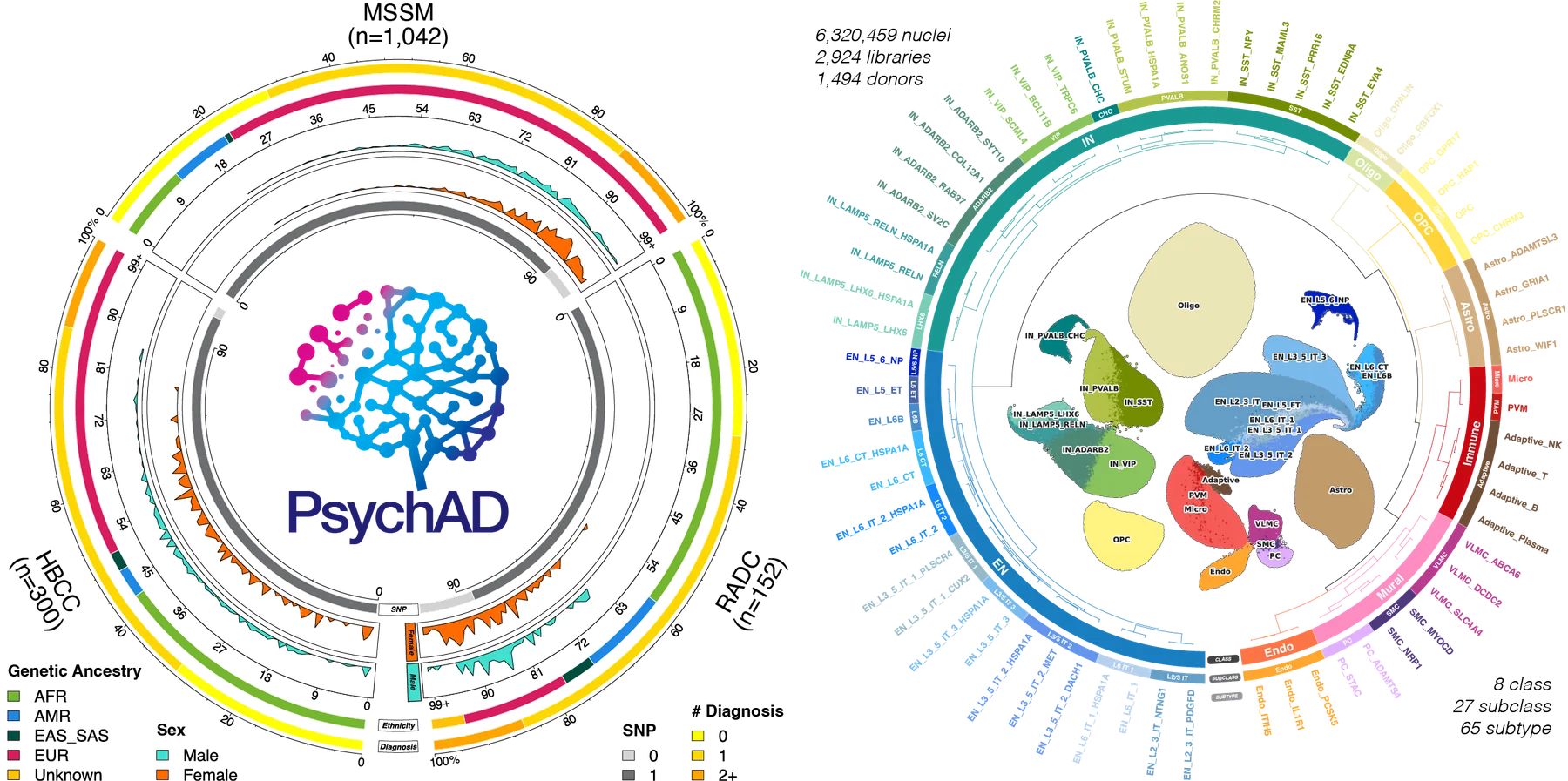
With the PsychAD consortium (R01AG067025) we built one of the largest single-cell atlases of the human dorsolateral prefrontal cortex: 6.3 million nuclei from 1,494 donors, spanning neurotypical controls and eight neurodegenerative and neuropsychiatric diseases. Comparing disorders side by side, we looked for the shared and distinct patterns of transcriptomic change, and for the genetic factors behind co-pathology. The variation across diseases pointed to a central process involving the neuro-immune-vascular system, with vascular cells as a key mediator of neurodegeneration in Alzheimer's disease.
A companion atlas of 284 neurotypical donors, aged 0 to 97, tracks how each cell type changes over a lifetime.
Research direction 02
Microglia & brain immunity
How do the brain’s immune cells change with age and Alzheimer’s disease?
Microglia and perivascular macrophages are the brain's resident immune cells, and many Alzheimer's risk genes are expressed mainly in them. FreshMG profiled 832,505 of these myeloid cells from the prefrontal cortex of 1,607 donors and sorted them into 6 subclasses and 13 subtypes.
They move fluidly between states with age and disease. One disease-associated microglia subtype, marked by high GPNMB, is enriched for Alzheimer's genetic risk and expands as pathology worsens. MITF holds cells in that state, and in human and mouse models its protective effect depends on TREM2. The paper was the cover story of the September 2026 Nature Genetics. Code: scMyeloidAD.
Research direction 03
Cell-type-specific genetics
In which cells do genetic risk variants for brain disorders exert their effects?
Most risk variants for brain disorders sit in non-coding DNA and act in only some cell types. We map genetic regulation at single-cell resolution and use it to connect GWAS loci to genes and to the cells where they matter.
The PsychAD eQTL atlas covers 5.6 million nuclei from 1,384 donors of diverse ancestry. It finds genetic regulation for 14,258 genes, including about 1,000 with cell-type-specific effects. A single-nucleus transcriptome-wide association study built on the same data links thousands of genes to brain disorders that bulk tissue misses. Earlier, we mapped how genetic variation shapes chromatin accessibility in specific brain cell types (Science, 2024).
Research direction 04
Machine learning for genomics
How can computational models reveal disease-relevant cells and regulatory mechanisms?
We frame biological problems in mathematical and statistical terms. With this much single-nucleus and functional genomic data, statistical modeling and machine learning are how we read disease genomes.
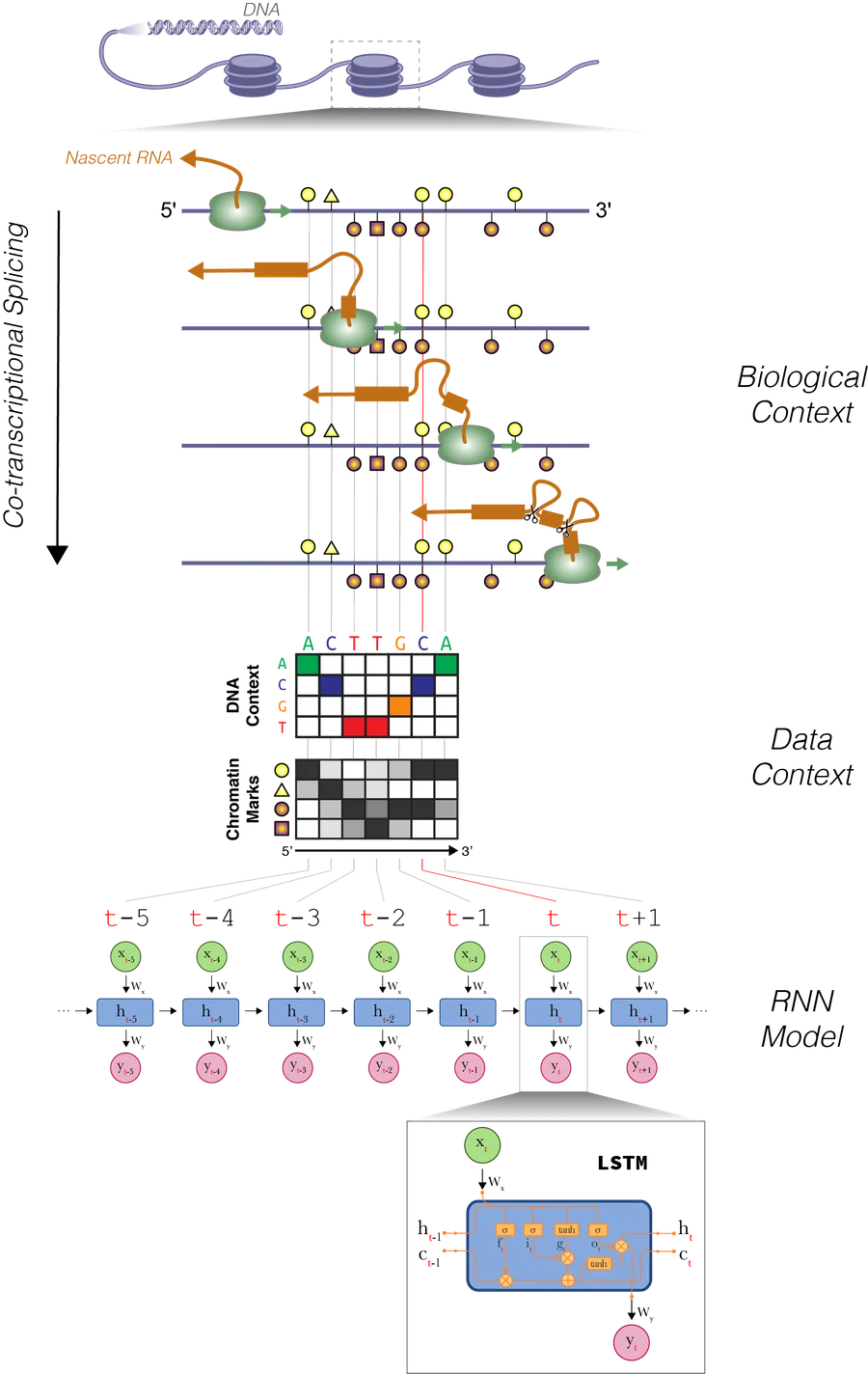
Recent examples include PASCode, which scores every cell for its association with a clinical phenotype, and iBrainMap, which builds a gene-regulatory network for each person. Earlier work includes ESPRNN, a recurrent neural network that predicts splicing from the epigenome, and DECODE, a deep learning model that refines enhancer boundaries.
Research direction 05
Gene regulation & networks
Which regulatory programs change in disease, and what drives those changes?
Integrative approaches can pull patterns and rules out of large data. We identify cis-regulatory elements, build gene regulatory networks and follow how regulation changes over time, with development, and in disease.
Recent work maps the regulators of the postnatal brain from infancy to late adulthood and describes gene regulatory programs of cognitive resilience in Alzheimer's disease. Before Mount Sinai, Donghoon built STARRPeaker to call enhancers from STARR-seq assays for ENCODE and studied how transcription factor networks rewire in cancer.