The PsychAD consortium’s work is on the cover of the 24 September 2026 issue of Nature. It is a milestone for our lab, our colleagues in the Center for Disease Neurogenomics and the wider consortium.
Donghoon Lee is first and co-corresponding author of the flagship study, Single-cell atlas of transcriptomic vulnerability across brain disorders. The work brings together single-cell genomics and human genetics to ask how brain diseases converge—and where their molecular signatures differ.
One brain region, eight disorders
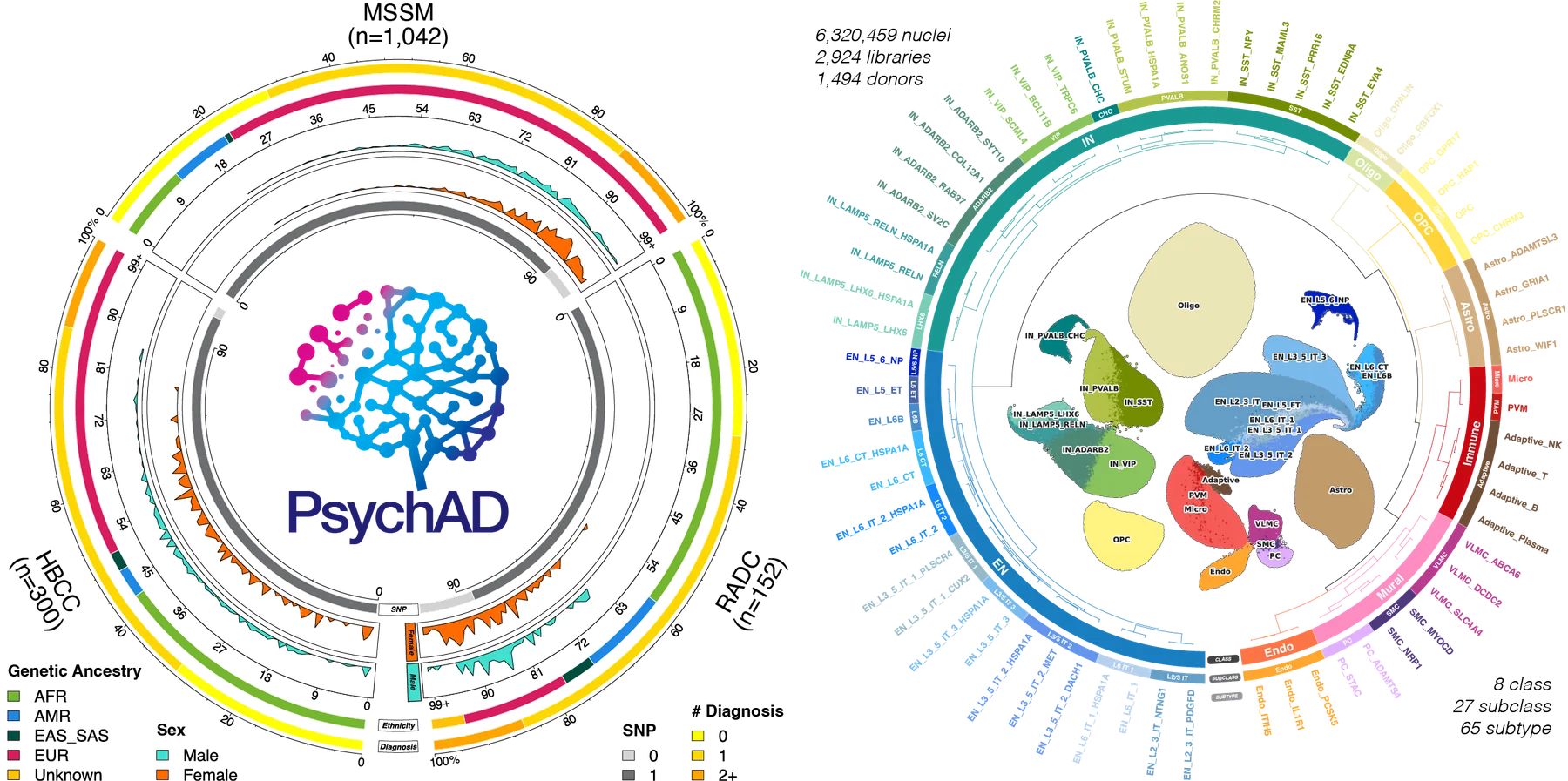
The PsychAD atlas is a single-nucleus RNA map of the dorsolateral prefrontal cortex. It has 6,320,459 nuclei from 1,494 donors, sequenced in 2,924 libraries, and it covers neurotypical controls plus eight disorders: Alzheimer’s disease, diffuse Lewy body disease, vascular dementia, Parkinson’s disease, tauopathy, frontotemporal dementia, schizophrenia and bipolar disorder. Having all of them in one dataset lets you ask what they share and where they part ways.
A few things stood out. Once you set aside the signal common to every disorder, Alzheimer’s, Lewy body disease, vascular dementia and Parkinson’s look closely related, both genetically and in expression. As Alzheimer’s pathology gets worse, neurons decline while immune and vascular cells expand, and the vascular cells look like a key go-between in that process. People with neuropsychiatric symptoms had more deep-layer excitatory neurons.
The nine papers
The flagship is one of nine companion papers from the PsychAD consortium, published across five Nature Portfolio journals. Three of them are in the 24 September issue of Nature.
The whole set is in the PsychAD collection on nature.com, and the consortium’s site is psych-ad.org. You can browse the atlas yourself on CELLxGENE.
Further reading
- The September 24 cover and issue
- Nature News: a landmark map of the brain’s gene activity
- Nature News & Views: the cellular atlas of brain ageing and disease
- Mount Sinai’s announcement
We are grateful to the donors and families whose contributions made this work possible.